
UX Design
Digital KYC Tool (DKT)
Modernizing AML reviews for BMO Commercial Banking. I replaced fragmented manual tracking with a systemized workflow that reduced turnaround time by 42% and eliminated structural data gaps.
Platform
Internal Web App for BMO Financial Group
Role
Lead UX/Product Designer
Timeline
Sept 2024-May 2025
UX Design
Digital KYC Tool (DKT)
Modernizing AML reviews for BMO Commercial Banking. I replaced fragmented manual tracking with a systemized workflow that reduced turnaround time by 42% and eliminated structural data gaps.
Platform
Internal Web App for BMO Financial Group
Role
Lead UX/Product Designer
Timeline
Sept 2024-May 2025
UX Design
Digital KYC Tool (DKT)
Modernizing AML reviews for BMO Commercial Banking. I replaced fragmented manual tracking with a systemized workflow that reduced turnaround time by 42% and eliminated structural data gaps.
Internal Web App for BMO Financial Group
Lead UX/Product Designer
Sept 2024-May 2025
Overview
Context & Background
Overview
Know Your Client (KYC) reviews are a critical part of anti-money laundering (AML) compliance in commercial banking.
At BMO, these submissions were managed through a fragmented mix of emails, spreadsheets, and legacy PowerApps, resulting in inconsistent data and expensive back-and-forth loops between bankers and analysts.
Users
AML Analysts responsible for reviewing and approving KYC submissions
Commercial Bankers submitting client information and responding to follow-ups
Constraints
Regulatory and compliance requirements limited flexibility in data capture
Multiple upstream and downstream systems needed to remain in sync
Accuracy and completeness were non-negotiable; in AML, a fast mistake is worse than a slow success.
why this mattered
Inefficient KYC workflows slowed reviews, increased rework, created ambiguity around ownership, and made it harder for teams to trust the status of a submission at any given time, decreasing worker productivity, and creating compliance bottlenecks that jeopardized client confidence and onboarding speed.
Overview
Context & Background
Overview
Know Your Client (KYC) reviews are a critical part of anti-money laundering (AML) compliance in commercial banking.
At BMO, these submissions were managed through a fragmented mix of emails, spreadsheets, and legacy PowerApps, resulting in inconsistent data and expensive back-and-forth loops between bankers and analysts.
Users
AML Analysts responsible for reviewing and approving KYC submissions
Commercial Bankers submitting client information and responding to follow-ups
Constraints
Regulatory and compliance requirements limited flexibility in data capture
Multiple upstream and downstream systems needed to remain in sync
Accuracy and completeness were non-negotiable; in AML, a fast mistake is worse than a slow success.
why this mattered
Inefficient KYC workflows slowed reviews, increased rework, created ambiguity around ownership, and made it harder for teams to trust the status of a submission at any given time, decreasing worker productivity, and creating compliance bottlenecks that jeopardized client confidence and onboarding speed.
Overview
Context & Background
Overview
Know Your Client (KYC) reviews are a critical part of anti-money laundering (AML) compliance in commercial banking.
At BMO, these submissions were managed through a fragmented mix of emails, spreadsheets, and legacy PowerApps, resulting in inconsistent data and expensive back-and-forth loops between bankers and analysts.
Users
AML Analysts responsible for reviewing and approving KYC submissions
Commercial Bankers submitting client information and responding to follow-ups
Constraints
Regulatory and compliance requirements limited flexibility in data capture
Multiple upstream and downstream systems needed to remain in sync
Accuracy and completeness were non-negotiable; in AML, a fast mistake is worse than a slow success.
why this mattered
Inefficient KYC workflows slowed reviews, increased rework, created ambiguity around ownership, and made it harder for teams to trust the status of a submission at any given time, decreasing worker productivity, and creating compliance bottlenecks that jeopardized client confidence and onboarding speed.
problem
A single, outdated intake form became a "black box" for KYC—offering no visibility, ownership, or continuity after submission.
All KYC submissions were captured through a legacy PowerApps form and effectively disappeared after completion.
Once submitted, there was no centralized way to track status or progress—forcing teams to rely on fragmented spreadsheets and "status-check" emails to understand what was happening.
This lack of visibility made even minor changes—such as adding a new entity or updating information—slow and error-prone.
Because submissions were inconsistent, analysts frequently received incomplete or duplicate requests, leading to constant "ping-pong" communication and delayed reviews.
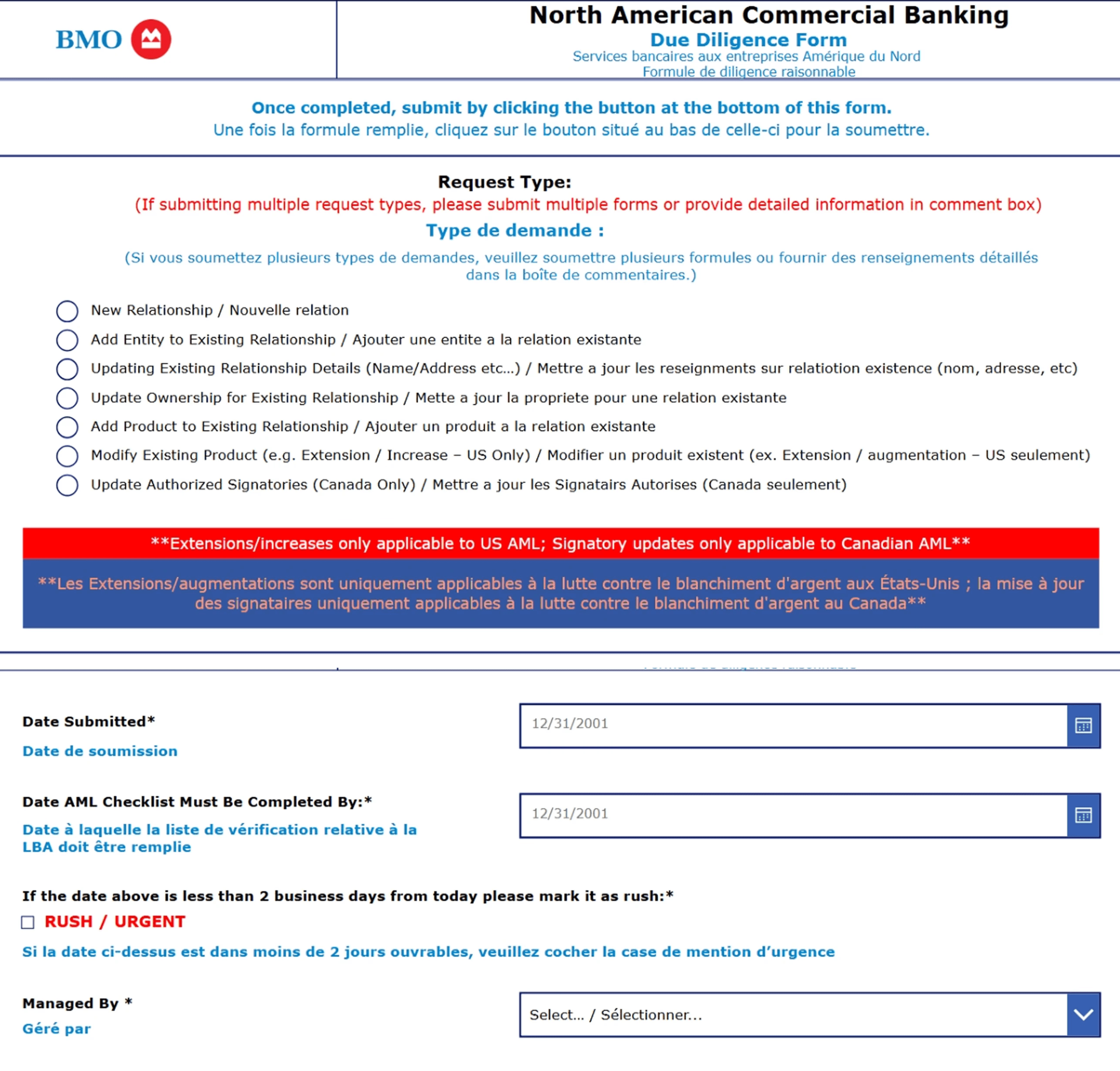
Legacy PowerApps form used for KYC intake.
problem
A single, outdated intake form became a "black box" for KYC—offering no visibility, ownership, or continuity after submission.
All KYC submissions were captured through a legacy PowerApps form and effectively disappeared after completion.
Once submitted, there was no centralized way to track status or progress—forcing teams to rely on fragmented spreadsheets and "status-check" emails to understand what was happening.
This lack of visibility made even minor changes—such as adding a new entity or updating information—slow and error-prone.
Because submissions were inconsistent, analysts frequently received incomplete or duplicate requests, leading to constant "ping-pong" communication and delayed reviews.
Legacy PowerApps form used for KYC intake.
problem
A single, outdated intake form became a "black box" for KYC—offering no visibility, ownership, or continuity after submission.
All KYC submissions were captured through a legacy PowerApps form and effectively disappeared after completion.
Once submitted, there was no centralized way to track status or progress—forcing teams to rely on fragmented spreadsheets and "status-check" emails to understand what was happening.
This lack of visibility made even minor changes—such as adding a new entity or updating information—slow and error-prone.
Because submissions were inconsistent, analysts frequently received incomplete or duplicate requests, leading to constant "ping-pong" communication and delayed reviews.
Legacy PowerApps form used for KYC intake.
Quote
"I don’t know if my form went through until someone emails me asking for clarification or information. Sometimes, my other submissions just disappear."
— TPS Role, BMO Commercial Banking
Quote
"I don’t know if my form went through until someone emails me asking for clarification or information. Sometimes, my other submissions just disappear."
— TPS Role, BMO Commercial Banking
Solution
We redesigned the KYC experience from a single, linear form into a trackable, guided workflow
The DKT is a workflow platform that turns KYC from a static submission into a continuously trackable process shared across teams.
Key shifts:
Centralized KYC status tracking in a single platform, eliminating spreadsheets, emails, and follow-ups.
A dynamic, guided submission flow that adapts to user inputs and provides contextual support throughout.
Direct integration with core BMO source systems, reducing manual guesswork and re-entry.
Solution
We redesigned the KYC experience from a single, linear form into a trackable, guided workflow
The DKT is a workflow platform that turns KYC from a static submission into a continuously trackable process shared across teams.
Key shifts:
Centralized KYC status tracking in a single platform, eliminating spreadsheets, emails, and follow-ups.
A dynamic, guided submission flow that adapts to user inputs and provides contextual support throughout.
Direct integration with core BMO source systems, reducing manual guesswork and re-entry.
Solution
We redesigned the KYC experience from a single, linear form into a trackable, guided workflow
The DKT is a workflow platform that turns KYC from a static submission into a continuously trackable process shared across teams.
Key shifts:
Centralized KYC status tracking in a single platform, eliminating spreadsheets, emails, and follow-ups.
A dynamic, guided submission flow that adapts to user inputs and provides contextual support throughout.
Direct integration with core BMO source systems, reducing manual guesswork and re-entry.
Process
How we approached the problem
02
Identifying structural failures
We isolated three core process breakdowns:
Implicit Status: Progress was invisible to stakeholders.
Fluid Ownership: Tasks shifted between teams without being tracked.
Coupled Validation: Data entry and follow-ups were too tightly linked, causing bottlenecks.
03
Reframing the solution
With these insights, we shifted the design approach from a "static submission form" to workflow management. We prioritized system structure and information hierarchy over visual design to ensure the platform could handle change over time.
01
End-to-end workflow audit
We mapped the KYC lifecycle across bankers and AML analysts, reviewing the legacy PowerApps form and shadowing live reviews. This allowed us to trace exactly where requests stalled or required manual rework.
04
Designed for visibility and ownership
We introduced explicit status indicators, ownership cues, and notifications so teams could quickly understand:
What was complete
What was open
What required action next
05
Validated with analysts and iterated
Designs were reviewed iteratively with AML analysts to ensure the workflow supported real-world compliance behavior.
This feedback informed final adjustments to terminology, data grouping, and validation logic before development began.
Process
How we approached the problem
02
Identified structural failures
We isolated three core process breakdowns:
Implicit Status: Progress was invisible to stakeholders.
Fluid Ownership: Tasks shifted between teams without being tracked.
Coupled Validation: Data entry and follow-ups were too tightly linked, causing bottlenecks.
03
Reframing the solution
With these insights, we shifted the design approach from a "static submission form" to workflow management. We prioritized system structure and information hierarchy over visual design to ensure the platform could handle change over time.
01
End-to-end workflow audit
We mapped the KYC lifecycle across bankers and AML analysts, reviewing the legacy PowerApps form and shadowing live reviews. This allowed us to trace exactly where requests stalled or required manual rework.
04
Designed for visibility and ownership
We introduced explicit status indicators, ownership cues, and notifications so teams could quickly understand:
What was complete
What was open
What required action next
05
Validated with analysts and iterated
Designs were reviewed iteratively with AML analysts to ensure the workflow supported real-world compliance behavior.
This feedback informed final adjustments to terminology, data grouping, and validation logic before development began.
Screens
Key screens and design artifacts
Selected moments that show how visibility, ownership, and prioritization were built into the KYC workflow.
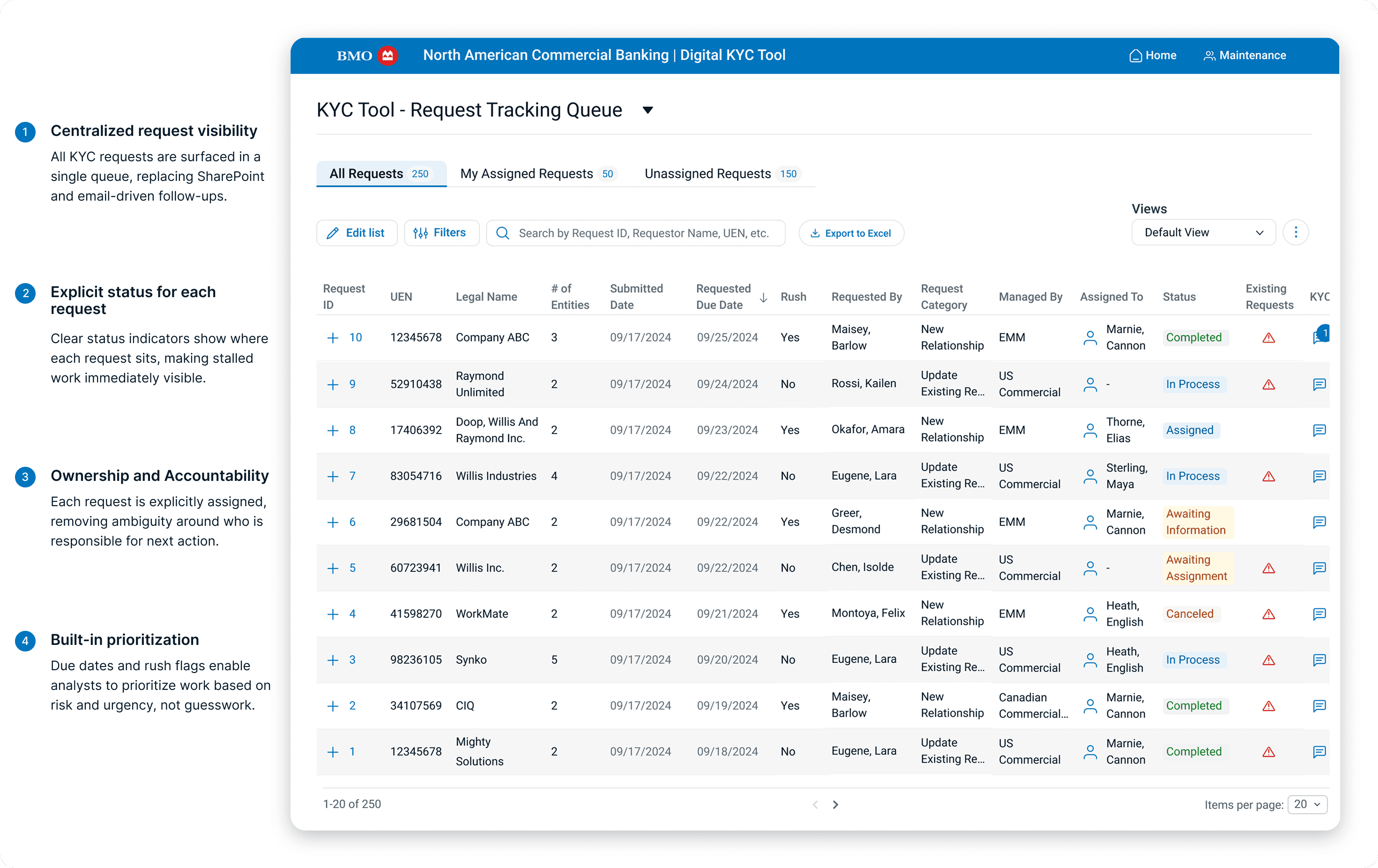
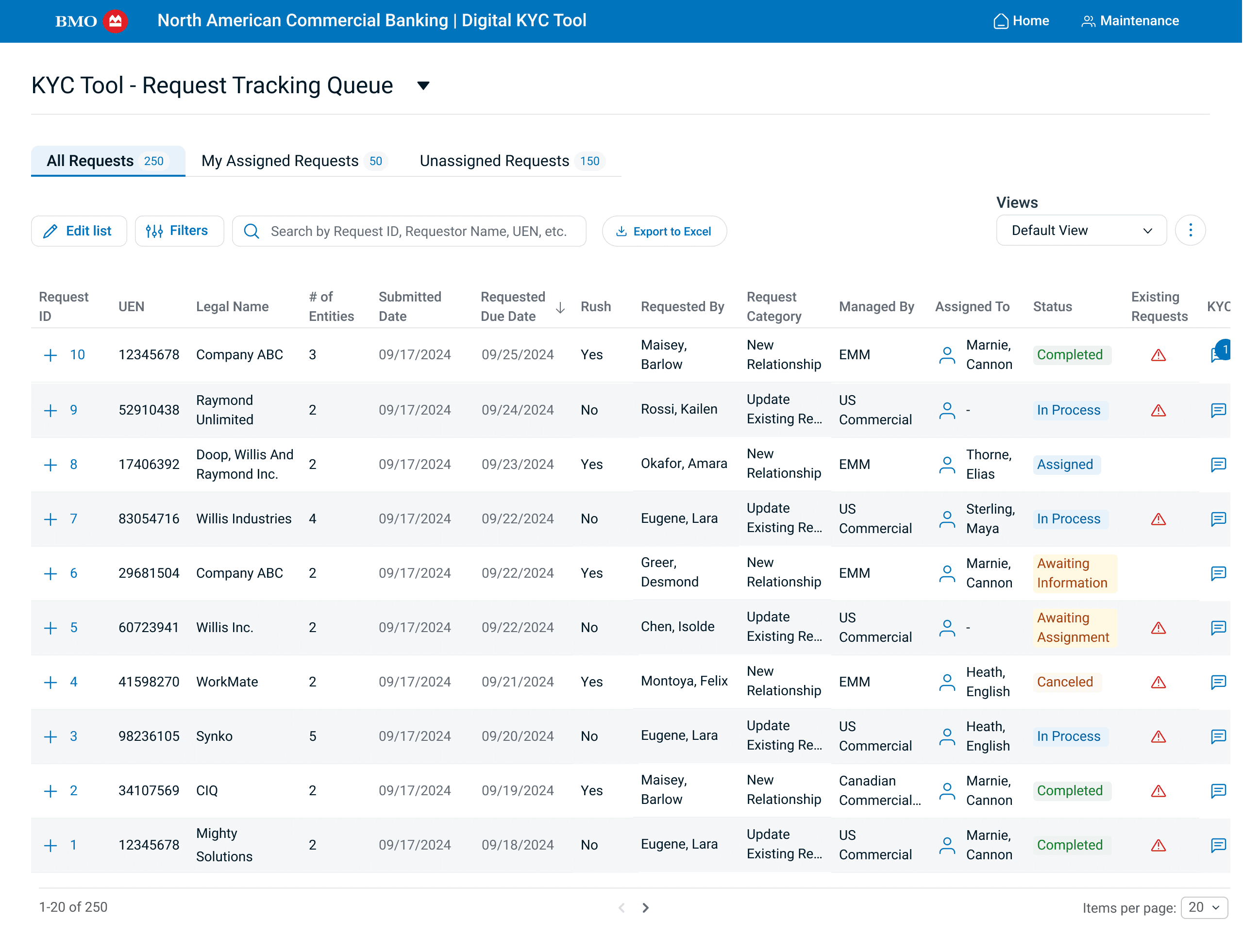
KYC Analyst Tracking Queue
A centralized analyst queue made request status, ownership, and prioritization visible across all active KYC work.
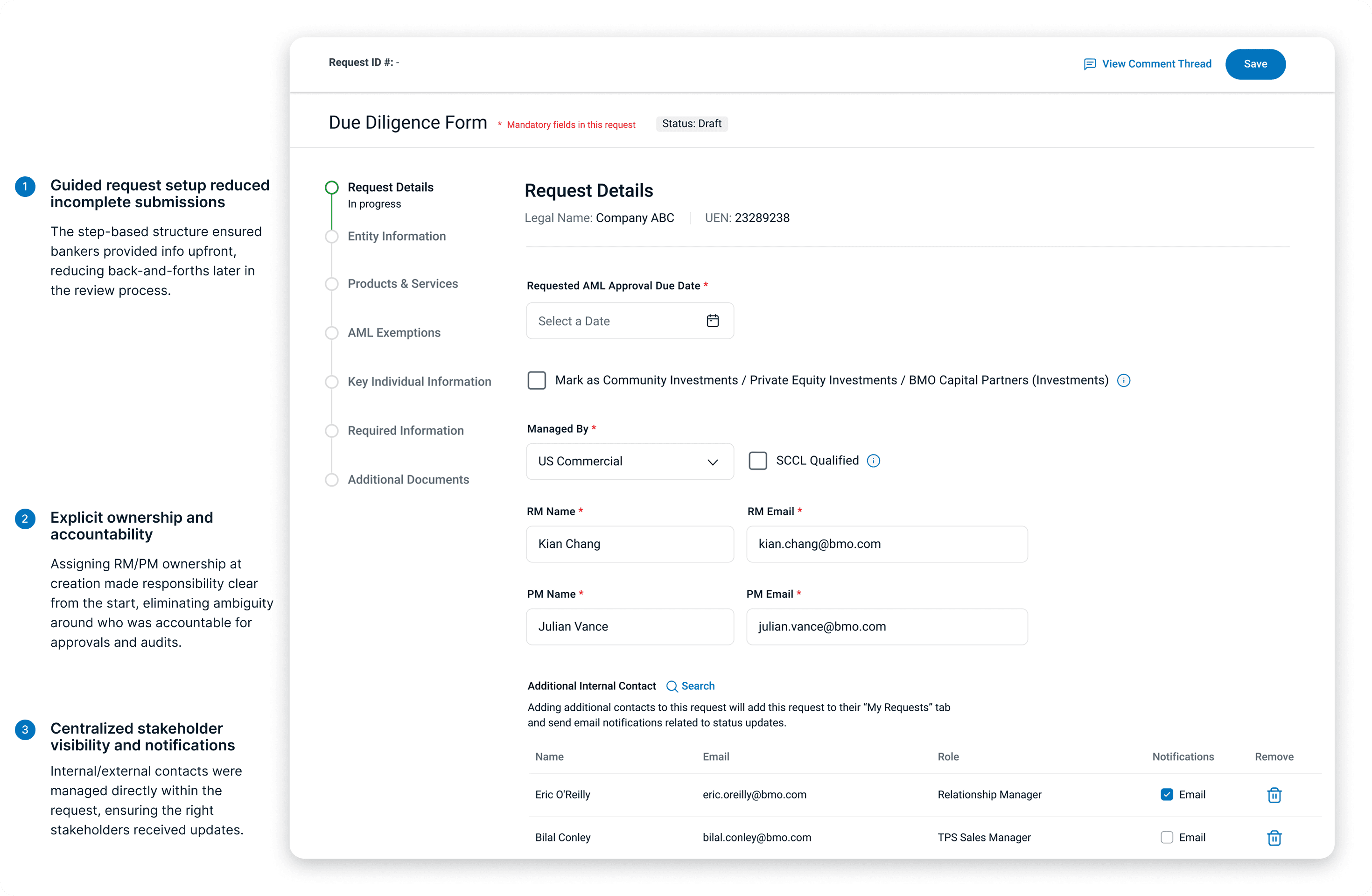
Request Details
A guided entry point that captured ownership, risk context, and stakeholders upfront; setting each KYC request up for faster, more predictable review.
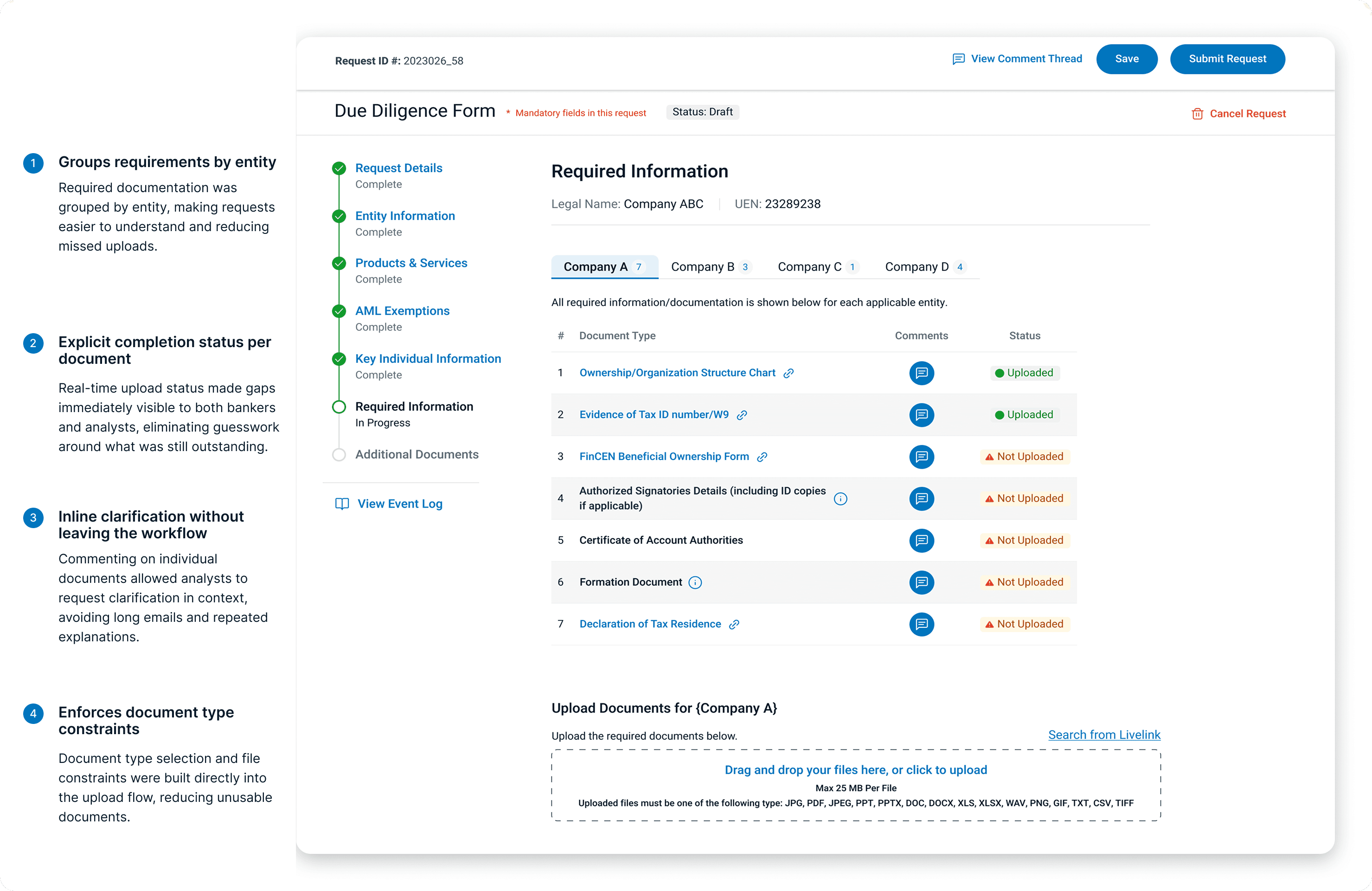
Required Information & Documentation
A structured, status-driven document workflow that made requirements explicit, reduced rework, and improved turnaround time for AML review.
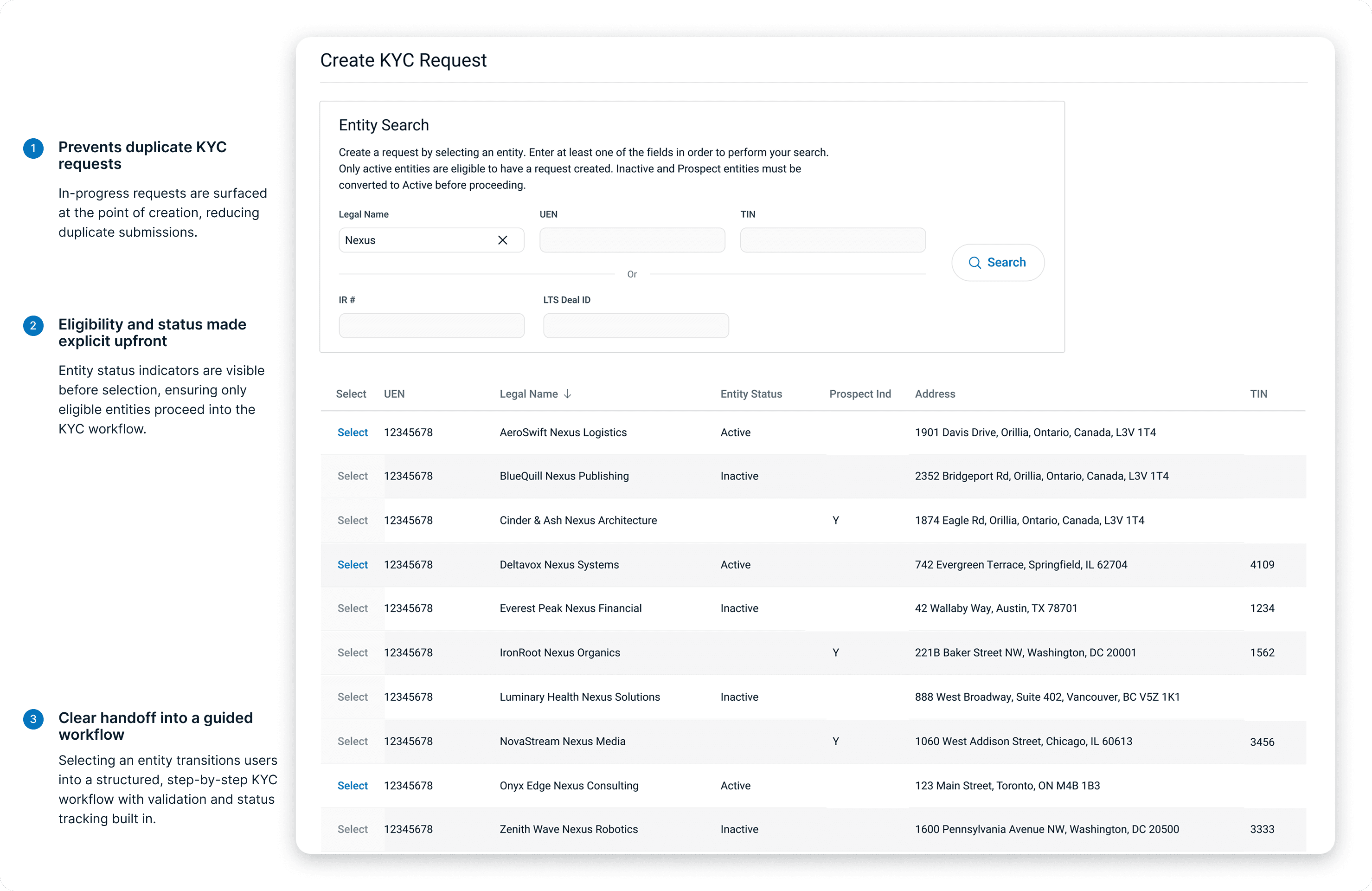
Create KYC Request (Entity Search)
A guided entry point that surfaces eligibility and existing requests upfront, preventing duplicate submissions and ensuring valid requests.
Screens
Key screens and design artifacts
Selected moments that show how visibility, ownership, and prioritization were built into the KYC workflow.
KYC Analyst Tracking Queue
A centralized analyst queue made request status, ownership, and prioritization visible across all active KYC work.
Request Details
A guided entry point that captured ownership, risk context, and stakeholders upfront; setting each KYC request up for faster, more predictable review.
Required Information & Documentation
A structured, status-driven document workflow that made requirements explicit, reduced rework, and improved turnaround time for AML review.
Create KYC Request (Entity Search)
A guided entry point that surfaces eligibility and existing requests upfront, preventing duplicate submissions and ensuring valid requests.
Screens
Key screens and design artifacts
Selected moments that show how visibility, ownership, and prioritization were built into the KYC workflow.
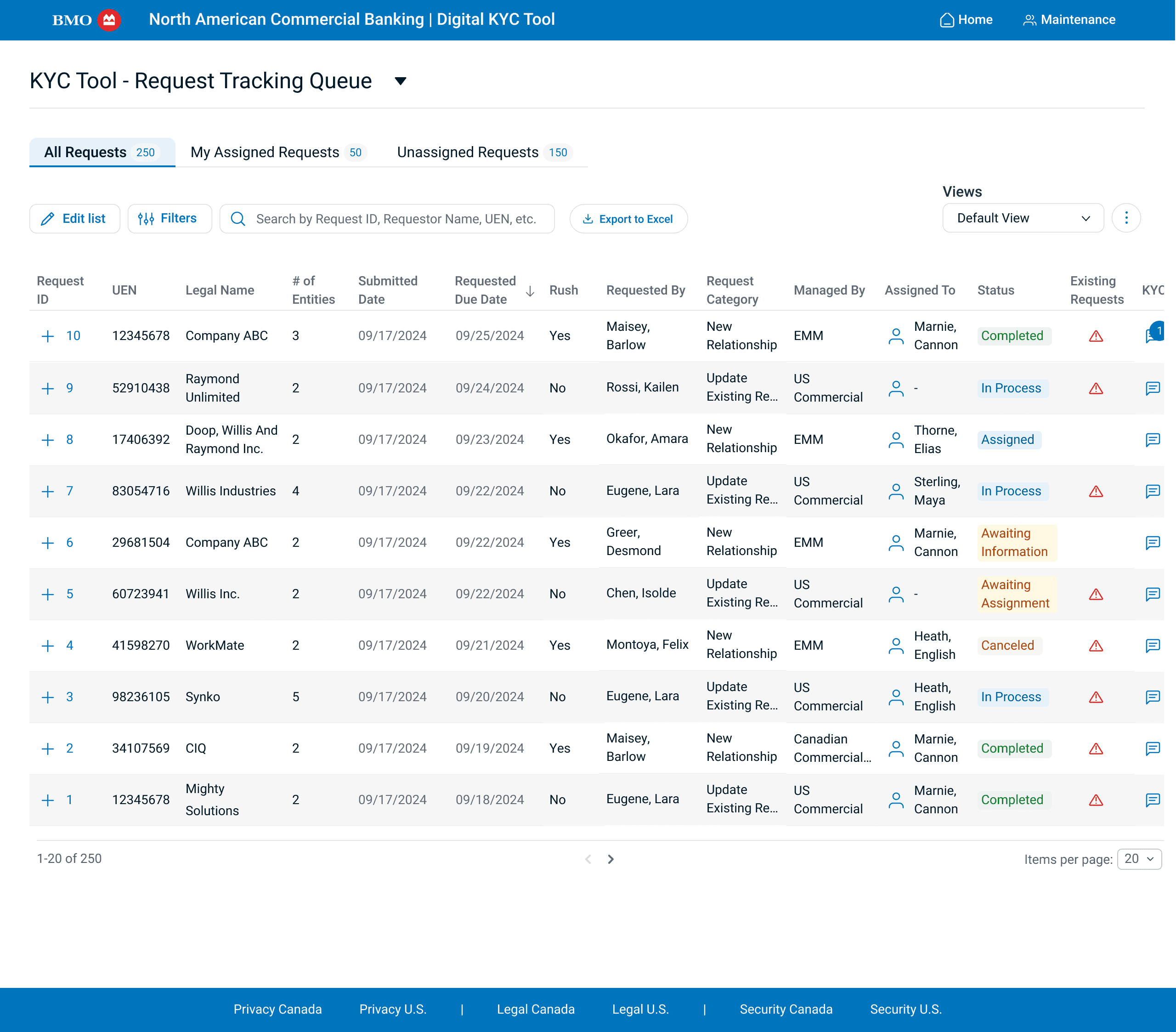
KYC Analyst Tracking Queue
A centralized analyst queue made request status, ownership, and prioritization visible across all active KYC work.
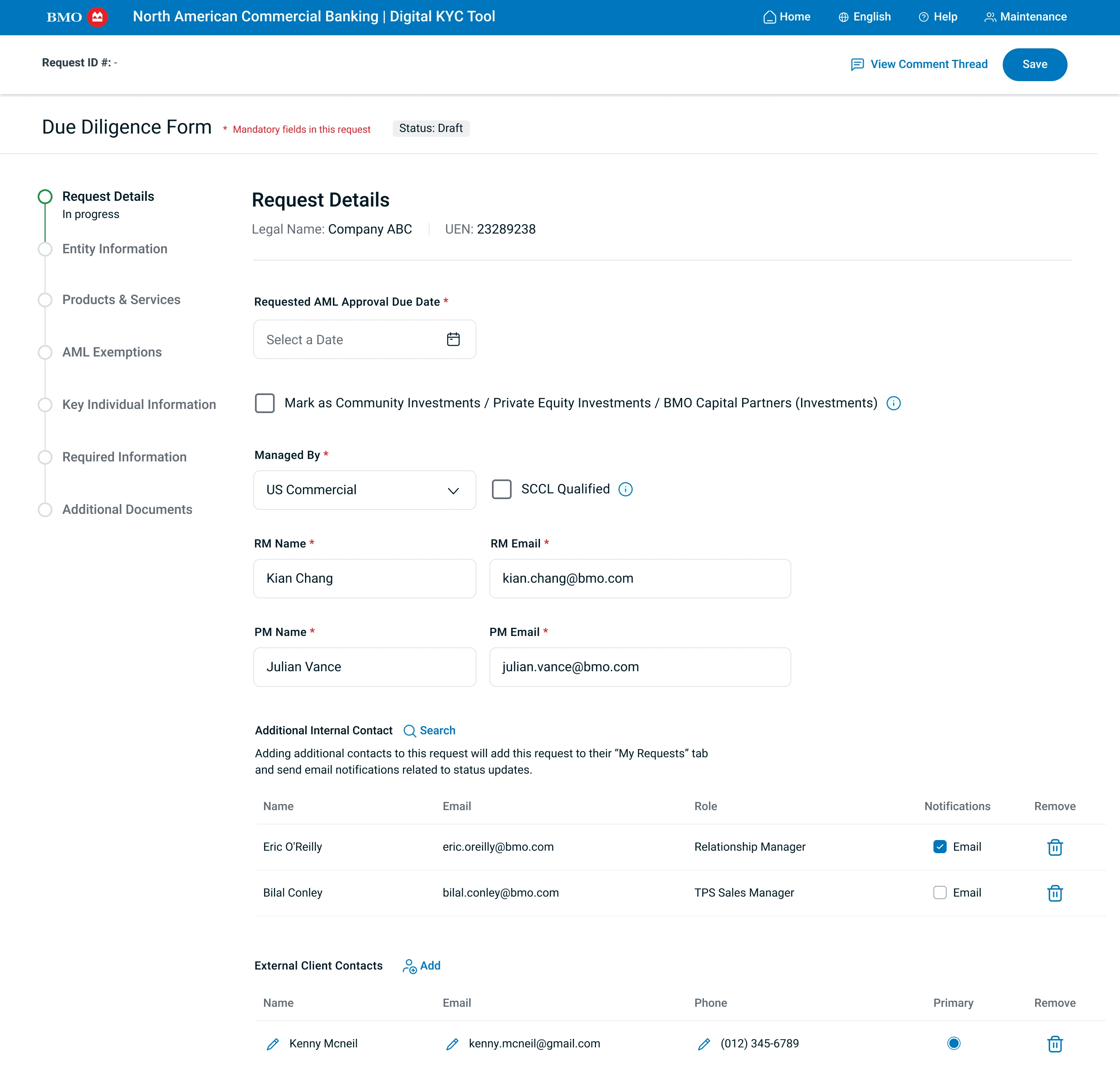
Request Details
A guided entry point that captured ownership, risk context, and stakeholders upfront; setting each KYC request up for faster, more predictable review.
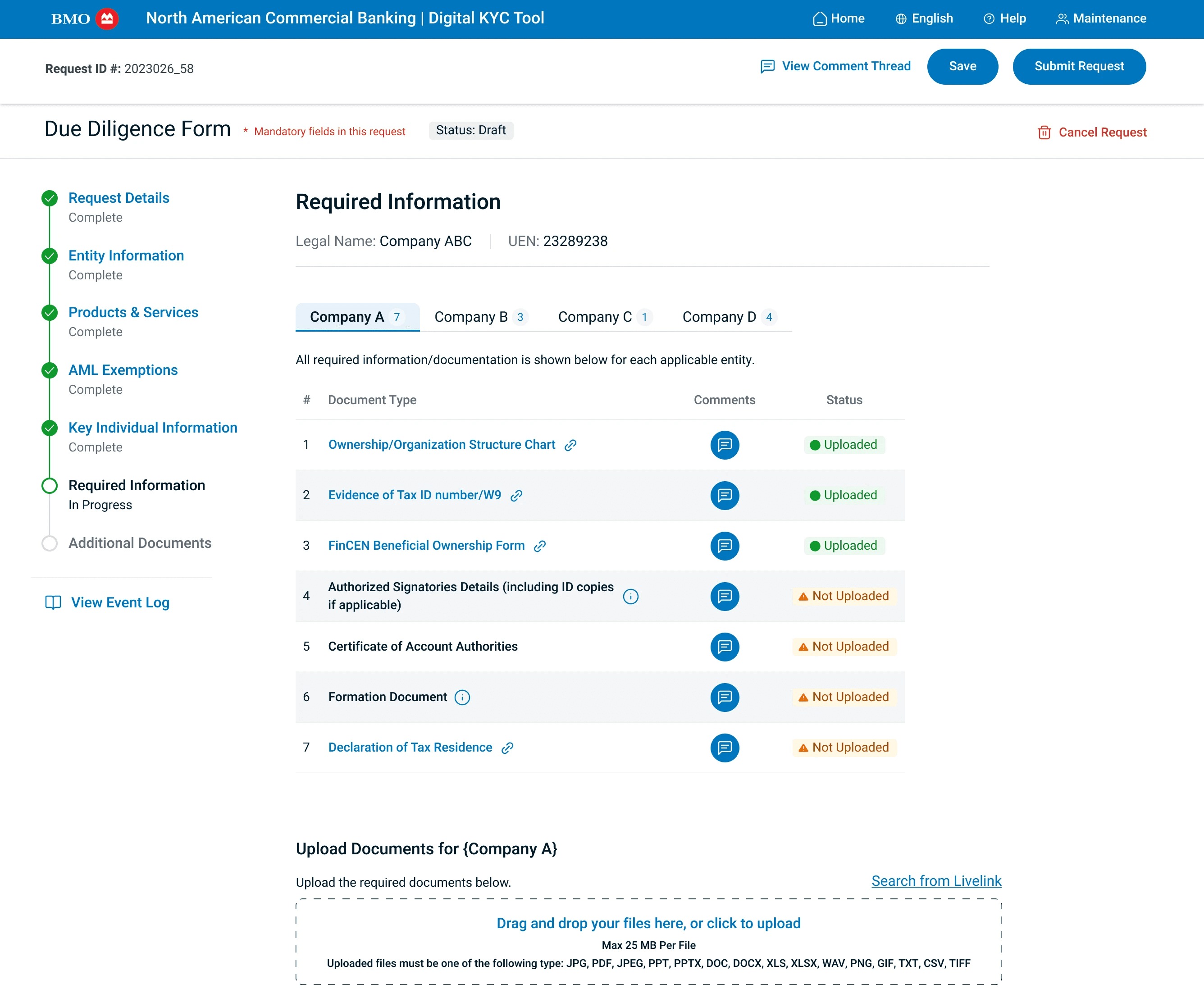
Required Information & Documentation
A structured, status-driven document workflow that made requirements explicit, reduced rework, and improved turnaround time for AML review.
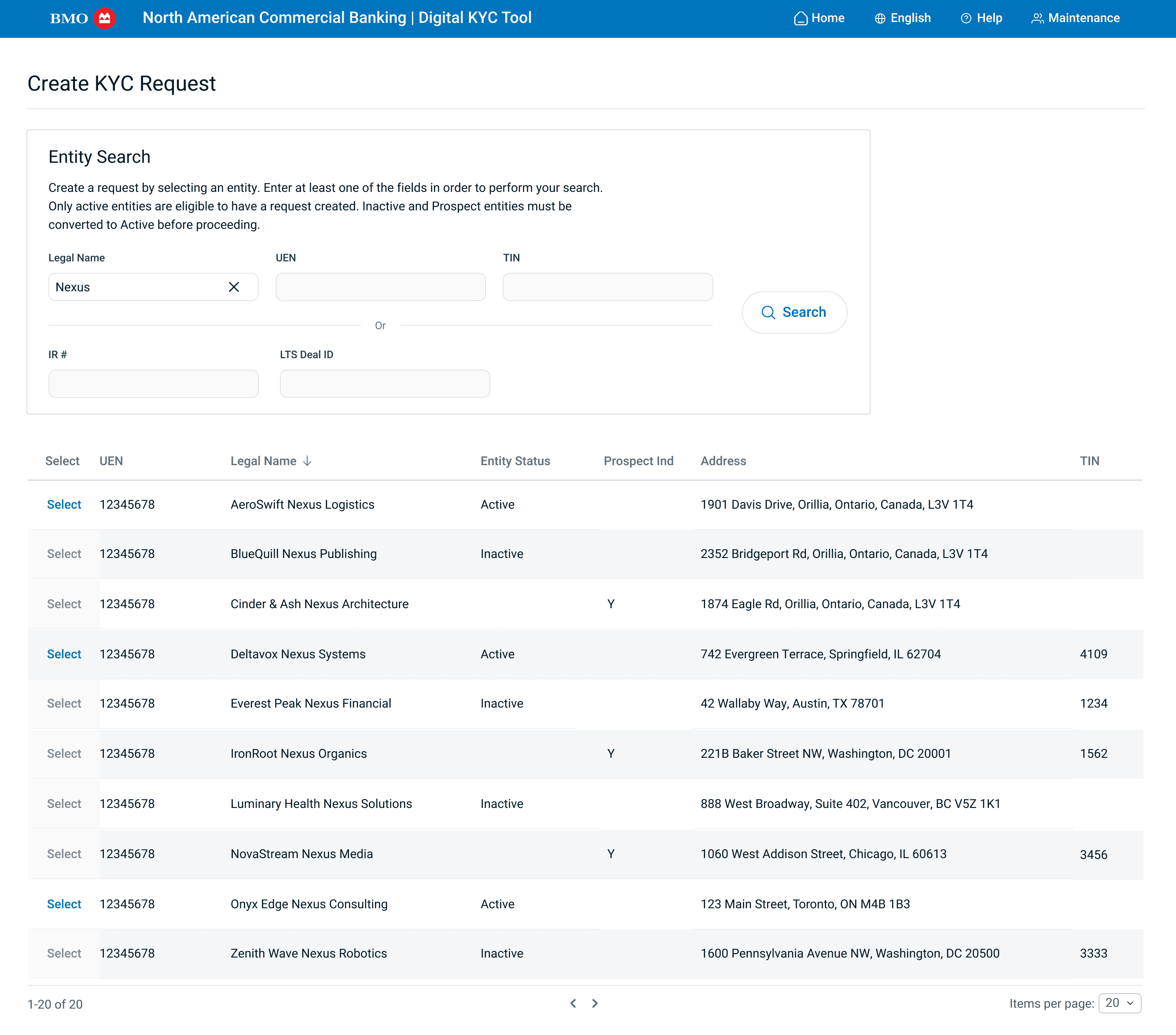
Create KYC Request (Entity Search)
A guided entry point that surfaces eligibility and existing requests upfront, preventing duplicate submissions and ensuring valid requests.
IMPACT
Improved visibility and ownership across the KYC lifecycle
Impact was measured through analyst feedback, operational reviews, and observed reductions in manual coordination during pilot and rollout.
97%
Preference for the new workflow over the legacy form
85%
First-pass yield (% of successful submissions on the first attempt)
↑ 42% faster
Average turnaround time (from 14 days to 8 days)
Bankers understood what was outstanding without chasing analysts
Analysts could prioritize work based on risk, due dates, and dependencies
The system scaled more predictably as KYC volume increased
IMPACT
Improved visibility and ownership across the KYC lifecycle
Impact was measured through analyst feedback, operational reviews, and observed reductions in manual coordination during pilot and rollout.
97%
Preference for the new workflow over the legacy form
85%
First-pass yield (% of successful submissions on the first attempt)
↑ 42% faster
Average turnaround time (from 14 days to 8 days)
Bankers understood what was outstanding without chasing analysts
Analysts could prioritize work based on risk, due dates, and dependencies
The system scaled more predictably as KYC volume increased
REFLECTION
Reflections and learnings
Visibility beats simplification
The biggest gains came from making status, ownership, and blockers explicit across the workflow—not from reducing form steps or visual complexity.
Terminology is a UX Pillar
In the KYC world, "Pending" can mean ten different things. Aligning on a shared taxonomy with AML analysts was just as important as the wireframes themselves to ensure the system felt intuitive.
Shared tools still need role-based views
Bankers and analysts interacted with the same requests but had very different needs. Providing distinct but connected views reduced friction without fragmenting the system, reinforcing the importance of designing for multiple roles within a single workflow.